|
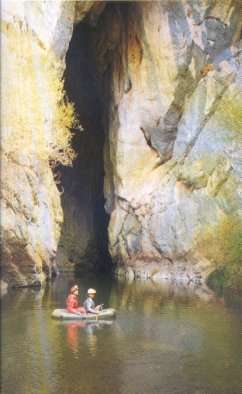
derebucak in cave
BALATINI CAVE
The cave is located with in the borders of Çamlik Village and Derebucak district in Beysehir - Konya you can arrive at cave by stabilized way, branched from 45 km of Konya - Beysehir - Üzümlü - Manavgat. The cave is situated 5 km far from Çamlik and 6 km from Derebucak. It is also 3 km northwest of Körükini and Suluin caves. Total length of cave is 1830m. and has two entrance from düden and fountain. The entrance, which is closer to the way, draws the water of little uvala and run down 2km south, from a cracked valley border, slope of Uzunsu river side. Balatini Cave is developed from two different levels, are an top of the other. The fossil branch surface of upper level is completely covered with cave clay and ended with the statue Room filled with the little statues made by the visitors. The lower level is the main gallery which contains the water. You can go through the gallery by foot when the level of water decreases. The three small pool, can be, passed by transition technique or by boat. The Statue Room and the natural rock sculptures are worth to be seen.
FEYZULLAH DÃœDENI (SINKHOLE)
That sinkhole is very close to Derebucak Village of Beysehir Town. That active sinkhole drained Gembos Polje at spring seasons.
KORUKINI CAVE
The cave is located 500m south-west of Çamlik Village in Beysehir-Konya. It can be arrived by stabilized way. The total length of cave is 1250m. and Uzunsu River is passing from inside of Körükini Cave after leawing the cave Uzunsu River pass from Degirmen Valley and reaches to Degirmenini Cave. The cave is completely active so that to pass the river, especially the parts where is waterfalls between rock blocks, and to use boat needs experimentation. Summer and autumn is more adviesable to enter the cave. In spring, it may be dangerous because of water and siphons.
Enter the dragon
Exploring the unknown depths of the remote and spectacular Turkish cave system of Altinbesik was the aim of the Dragon Cave Diving Expedition, although nothing ever turns out quite as planned.
Martyn Farr describes the adventure
ALTINBESIK CAVE
The cave is located near Ürünlü Village, 7 km from Ibradi Village in Akseki - Antalya. From Antalya to Ibradi you can go through highway. The way between Ibradi and Ürünlü is stabilized. You can also arrive to cave by a 5 km. away from village to Manavgat River. The water which comes from Büyükdüden, Oruçdüdeni and Feyzullah Düdeni is discharged to Manavgat River by Altinbesik Cave. The examined part of cave is 2200 m. The cave begins with a lake from the entrance. The lake's length is 125 m. The depth of cave reaches 15 m. in some parts. In the mid part of lake there is a natural bridge. First lake ends at the nearly vertical travertine barrier which has 44 m. height. There are also 2 lakes on the travertine. After the travertene the cave goes with 3 branches and the active branch was examined up to a hole of 8 m. height. The cave was covered with travertene and fissures completely, except the fossil branch. Main conduit is supposed be at the end of first lake.
The mules lurch from side to side, slipping and stumbling on the cobbled street. Strapped to their backs are 18 cylinders and a vast array of other technical hardware. It has taken us more than two years to prepare for this "high-tech" expedition and here we are employing one of the oldest forms of transport in the world - a muletrain - as the only way to get our kit to the site of our intended exploration.
In a team of six, we have come to the Taurus Mountains of south central Turkey to tackle some of the most challenging cave sites on the planet. Our quest is original exploration at the bottom of the 1000m-deep Manavgat Gorge. Set beneath deep-blue, cloudless skies, the river Manavgat has carved its way through incredibly tortured geology to form one of the most rugged, remote and inaccessible limestone valleys in the world.
At the foot of the gorge lies the renowned and perhaps most beautiful cave system in the country, Altin- besik Cave. This is a huge cave by any standard.
During the winter and spring, the water level in this cave rises by more than 80m, completely flooding most of the known system before thundering out into the Manavgat Gorge.
In early summer, the outflow suddenly ceases and a sombre silence settles on the underground galleries. It has been suggested that the water that disappears into the ground on the southerly shores of Lake Beysehir reappears in the gorge after a subterranean journey well in excess of 30 miles. This is certainly one of the longest underground drainage conduits in the world, and to date remains wholly unexplored. It would appear that Altinbesik Cave is associated with this network in some way.
Into the underworld
Altinbesik could almost be described as a fantasy world. As we discovered on a reconnaissance trip in 1997, the underground terrain and frequent obstacles could have come right out of an Indiana Jones film.
Set beneath towering cliffs, the entrance is vast - perhaps 40m wide by 40m high. It is occupied by a deep and tranquil lake, a pool of turquoise water running away into the blackness.
Some 200m from the entrance, the waterway terminates abruptly in a cul-de-sac. On three sides the walls rise sheer for as high as the eye can see, and draped into the vastness of this "terminal" cavern are flows of calcite, containing crystals that sparkle like gems in the light of our lamps. This place has the atmosphere of some vast flooded cathedral.
The only way forward is by climbing. This ascent is the key to accessing the major part of the system, and involves a 44m vertical climb directly above the lake.
From this lofty balcony, we look out on the twilight world of the lake far below. Ant-like, the boats carrying the rest of our team glide across the mirror-like surface and disappear beneath the overhanging walls.
Unclipping from the rope by which we scaled the climb, we turn to be confronted by the next lake, another deep, wide and black waterway that disappears into the vastness below.
The cave continues in this vein: lake after lake interspersed with slippery, razor-sharp rocks and short climbs. After the fourth lake, the profile of the cave changes. We emerge into an enormous hall where the floor falls away steeply. Black, brittle rock gives way to wet mud, then sand, and ultimately to shingle.
About a mile from the cave entrance and 80m below the level of the last lake, we arrive at the sump. This is the first objective of the Dragon Cave Diving Expedition and is the most serious obstacle in the cave so far.
Geared up
The dive logistics are immense. To field a team of three through the first sump and on to the "end" of the cave requires very careful preparation. From the outset, we planned the undertaking so that, if necessary, we could camp beyond the first sump.
To this end, the transport of equipment both through the cave and through the flooded section became crucial. Apart from conventional steel cylinders, we used ultra-lightweight carbon-fibre "composite" cylinders. But, despite being significantly less than half the weight of steel bottles of similar capacity, a considerable quantity of lead must be carried to counter their buoyancy.
However, by this approach the overall weight of equipment can be spread more evenly between the divers and some lead can be abandoned at the furthermost dive site and not have to be brought out of the cave at the end of the trip.
SCI-EFIC at Nottingham supplied the expedition with a variety of cylinders up to 300 bar, fitted with special cylinder valves manufactured to a high specification by Midland Diving Equipment.
For the underwater "ferrying" of equipment, we were using Draeger Dolphin semi-closed-circuit rebreather units. These give clear advantages in terms of gas duration, and were ideally suited to the project due to their ease of maintenance.
One of the more interesting difficulties we experienced concerned nitrox, which is generally unavailable in Turkish recreational diving. Thanks to advice from the European Diving Centre, we were ultimately able to blend our own supply. Things are just that little bit different in Turkey - oxygen, for example, comes in lovely blue cylinders, and fittings are far from standard.
Reaching the end
We have allowed three weeks for the project, which, if all goes to plan, will be ample time to reach the terminal lake and mount one or more missions into the unknown. Within 10 days, we have rigged the cave with a full complement of equipment and passed the first sump.
The flooded section is vast - a huge tunnel perhaps 30m or more wide and 5-7m tall. From air to air, the dive is more than 120m in length, with an average depth of 17m. The floor is littered with the largest cobbles I've ever seen, while the roof is plastered with fine sediment that quickly reduces visibility to less than a metre.
This obstacle had first been passed by a Czech expedition in the early '90s which had subsequently returned to progress the exploration to a point approximately two miles from the cave entrance.
Given the sheer immensity of the place, a compass bearing proves to be the most effective navigational aid, as the original guideline has long since been swept away in the dramatic winter floods. To lose the line in a site such as this doesn't bear thinking about!
The terrain beyond the sump gives little respite from difficulty as the cave rises steeply from the sump pool through an absolute chaos of muddy boulders. This area contains the largest cavern in the system, which quickly takes us once more to a height of 70-80m above the level of the sump pool.
Only at the very highest point can any footprints be faintly discerned in the sediments. Evidently, this whole section of cave is completely flooded in the winter - a sobering thought. From the high point, an equally steep slope takes us down to what proves to be another sump.
A shredded length of old line is a clear indication that this is in fact the route forward, while a climb directly above shows that in all probability this barrier is very short. From the vantage point 15m above the sump, we can see another large cavern just ahead, but on this occasion without the necessary equipment to descend the drop, or to dive through the flooded section, we are forced to withdraw.
At this point, the fickle hand of fate comes into play. It transpires that part of our political "permission" is not in order. Despite lengthy - and expensive - undertakings before the expedition, we now find ourselves compelled to secure the necessary paperwork, or risk the same fate that had befallen our predecessors. The Czechs had returned to continue the exploration of the cave in 1997, only to be refused access. In fact, they were turned away (out of the country) without being able to venture underground at all.
We spend several days trying to resolve the problem before we can resume activity. Given the delay, all our plans are thrown into the melting pot. The limited time we now have renders it impractical to continue with the original objective.
New discoveries
But every cloud has a silver lining - when two of the team discover a far more exciting project at Martal Cave, the decision to withdraw from Altinbesik becomes suddenly much easier. Turkey is experiencing a major drought, and in a flooded, undived cave just a mile away the water level has dropped to such an extent that an airspace has been created. A gap of around 50cm has now appeared over a deep lake, and through this opening a gale-force wind is now blowing!
Our expedition is back on track. In the days to follow, we explore Martal Cave and discover more than a mile of immense cave passages, including one of the largest underground caverns in the world - a void some 100m in diameter that generates distinct feelings of agoraphobia. Huge boulder blockages eventually obstruct the way, but there is, as is often the case, a distinct possibility of being able to bypass such obstructions by diving.
The Dragon Cave Diving Expedition, sponsored by the Sports Council for Wales and others, was a hugely rewarding venture. It explored a major new and previously unknown cave system, and gained a wealth of information about a number of other sites. And, as for Altinbesik Cave, which will probably be proven to extend for an incredible distance under the Taurus Mountains, diving is assuredly the key to its exploration.
Certainly, the Manavgat Gorge is one of the most attractive exploratory propositions of our time, and today is an even greater challenge to those who will follow in the future.
AYVAINI CAVE
Ayvaini is located at the vicinity of Ayva Village (Bursa). It is an active river cave. It is possible to enter the cave from Doganalan entrance with -17km descend and exit from another point which is at 1 km southwest. of Ayva Village. The cave includes many lakes, in spite of increasing water it can be passed even at spring time.
BIYIKLI SINKHOLE
Biyikli is one of the biggest sinkhole in Turkey. It is to the Biyikli Village at 30km north of Antalya city. The water which sinks in Biyikli, emerges the from Kirkgöz springs located at 2.5km northwest of sinkhole. The water sink in the siphon is remerges from Varsak doline which is located 15km southeast.
BÃœYÃœK DÃœDEN CAVE
The cave is in Derebucak district of Konya Province. It is at the 18th km. in the direction of Ibradi from Derebucak after Konya-Beysehir-Derebucak road, and it is situated at the west side of Kembos Plain. Kembos Plain with a width of 1km and a length of 15km drains the snow water melting in the spring and especially the water accumulated here via Uzunsu Creek by means of Feyzullah sinkhole, another chasm. Water sinking from these points is added to Manavgat Creek by passing through Altinbesik Düdensuyu Cave. Although the cave does not have a touristic importance, it is important regarding the speleological aspect. There exists numerous lakes, big halls and siphons in this sinkhole which has a length of 714 meters.
CUMAYANI CAVE
It is situated in Cumayani quarter at 3 kms. distance from Çatalagzi district of Zonguldak province. It forms the outlet of Kizilelma-Cumayani underground water system. It is opened to outside with many inlets. The hall is reached through a active gallery of 100 meters from the lower inlet or by walking for 75 meters from the upper fossil dry inlet. The hall begins with a travertine offering an extraordinary beauty and functioning as a bridge on the underground creek. The base of the hall, which has a height of 60 meters and a length of 70 meters, is covered with a thick sand layer and ends with a siphon. Upon going in the direction of water entrance to the left of the travertine, the siphon is reached in the direction of Kizilelma Cave. A boat is necessary in this gallery. As flood occurs in the rainy periods or at the times of a sudden rain, there exists a danger of life. Because of this, one should be careful.
ÇAYIRKÖY CAVE
It is at 1km. distance from Çayirköy which is 3kms. north of Güdüllü Village at the 10th km. of Zonguldak-Çaycuma road. Sofular and Egridere streams sinks at Çayirköy Cave inlet, continues underground for 1004 meters and drains from Çayirköy. The inlet begins with a vertical fall of approximately 30 meters and then reaches to the siphon. The siphon can hardly be passed at the times when the water level is low. After this point, the cave continues horizontally together with the lakes, and there exists a deep lake at the end of it.
DUPNISA CAVE SYSTEM
The cave is located at 5-6 km SW of Sarpdere Village of Demirköy, Kirklareli. One can arrive at cave with jeep or tractor. The cave has 3 entrances. The total length is 3200 m. The first 1000m. from the entrance is active. The fountain originated from the cave, is establishing Rezve River. This river is also the border between Turkey and Bulgaria. One of the entrance is Dupnisa Dolin entrance. The second entrance is dry cave. Dry cave begins with two different entrances one of them is 363m and the other one is 456m. The third entrance called Kiz Cave and begins with a slope of 60 degree. The side branches of cave is fossil and the main system is active. In the cave there is a hole which has dimensions 150x60m.
DÃœDENCIK SINKHOLE
It is at the near vicinity of Cevizli town which is located on Beysehir - Akseki road. It was believed to be the deepest cave of Turkey until 1989 (-300m). Water spring seasons.
GOKGOL CAVE
It is situated on the road at Üzülmez district at the 4th km. of Zonguldak way of Zonguldak-Ankara highway. Water coming out of the cave drains into the Üzülmez Creek. It is entered out of a huge fossil inlet through the rock blocks. The siphon is reached after 250 meters by walking. Although the siphon has a length of 10 meters, it can be passed especially in summer. After this point, the cave continues as two branches in the direction of water entrance along with the extremely beautiful formations. The cave continuing for 1200 meters and ends with a sediment filling. (The port after this point is not known, yet.) While the creeks and inner lakes are passed easily by walking, sudden flood occurs during big rains. Because of this danger, it is proper to enter this cave in summer and autumn.
HIZAR CAVE
Hizar cave is close to Safranbolu town of Zonguldak city. It is a horizontal and inactive cave. It has a big entrance and a big channel which has three passage. There is a lake shape siphon at the secondary passage of the first passage. There is a water discharge from a siphon which is at 50m down altitude from cave entrance. It is jointed to that part with a vertical pit.
HISLAYIK CAVE
Hislayik Cave is in Ayranci town of Karaman city. It is descended to an underground river with a 26m pit. The cave is separated to the two side to left and right. Each passage is starting with the siphon and continues with siphons. The exploration of this cave continues. Total length of the cave is 260m as of 1990.
ILGARINI CAVE
The cave is located in Derebucak village borders in Cide - Kastamonu. Once can reach the cave by walking approximately 5 hours from Derebucak to the NE direction. The total length is 860m. and depth is -250m. The cave has two parts: horizontal part is fossil and the vertical part is active. Water cisterns and leftovers of houses from Roman - Byzantium period can be found at the entrance of cave. Also you can find a way, which is established from 24 spiral and covered with hand made stone, at the beginning of vertical part. By taking this way, one can reach a pit whose depth is 52m. and diameter is 30m. After this you can reach a siphon whose floor is covered with travertine and very nice formations look like chandelier. It is hard to access to some branches because of their elevations from main passage. In these parts ornamentations are protected up to today. The technical equipment is required in the vertical part.
INAGZI CAVE
It is a cave situated in the city of Zonguldak province at the sea coast at the 15th km of Kilimli road. The entry to the cave with a total length of 800m is made from the fossil inlet facing the sea. After a hole one man can hardly pass at the 50th meter it continues sporadically with fossils and rich formations and sporadically with an underground creek. There exists a siphon at the 400th meter, and it can be distinguished by walking in the period when water is drawn. From here, it ends with the siphon after 400 meters.
INCESU CAVE
Incesu cave system is situated at 7 km. south of Taskale town 45 km. far from Karaman province in southeast direction. The site is arrivable by all means of transportation facilities. The system is formed by two continuous separate caves. The horizontally extending caves are richfull with stalactive and stalagmite formations. One can follow an underground river in wet seasons from Incesu cave (1356 m.) to Asarini cave (750 m.) despite it has been closed by collapsed blocks.
INDERE CAVE
It is situated at Ballica village which is about 5km. away from the district of Pazar town of the province of Tokat. The cave is located on the side of Indere valley and starts with a fossil opening at the height of 1180 meters. General morphologic constitution shows large halls created as a result of collapses and connected to each other with passages. Especially at the hall with bats and the hall following, the floor of the halls are not clear because of guano which covers the collapsed blocks. In order to be able reach to these halls, vertical speology technics must be used (there are 10m. and 7m. length descents). Inside the cave which has almost completed its development process and especially at the large hall there are many interesting structures such as columns with lengths over 10 meters, travertines with like mushroom caps, and what is more important are the onion like structures with sizes starting from 30cm up to 7 meters. Furthermore, a very spread bat population could be seen. On the other hand, the entrance of the cave is not protected by any way and means and so necessary action must be taken for proper protection against any harm which could come from people around or people visiting the place.
KIZIL ELMA CAVE
The cave which is situated in Kizil Elma quarter of Ayiçi Village of Gelik District of Zonguldak Province can easily be reached by cars. Water of Aydin Creek and Büyük Ay Creek sinks at the active inlet. The cave is entered through the fossil inlet (30x10m.) located at the upper part, and after 100 meters water is met. The cave continue horizontally together with the water. After the first 100 meters, it is possible to go by creeping for 400 meters, a siphon of 10 meters exists. This siphon can be passed in the Autumn. The gallery in the cave has great dimensions after the siphon. At the 3200th m. of the cave which continues as a single active gallery basically, there is a chimney with the height of 80 meters which is enough to illuminate the lake at the base. The cave continuing 3 kms along with the lakes ends with the 2nd siphon. The researches related with some branches and the last siphon in the cave has not been concluded, yet. It has been determined via the researches carried out by paint experiments that the sunk water appears in Cumayani Cave after 2 kms. Thus, the total length of the underground system (Kizilelma-Cumayani) reaches to 10kms. Once, it was the longest cave system of Turkey. However, when it has been discovered that Pinargözü Cave has a length of 12 kms in 1991, this cave has been placed in the 2nd order. Its siphons, areas of cripping, lakes and funnel of 80 meters are the characteristics, or perhaps the most exciting aspects of the cave. As there is a danger of flood in the rainy periods, the season and the weather forecast should be taken into consideration while entering the cave.
KOCADÃœDEN CAVE
The sinkhole is located at the southwest margin of Akseki Polje. It could be reached by the Pathway from the fourth km. of Akseki - Bucakkisla main road. The sinkhole has many lakes and it ends with a siphon. Total depth of the cave is -155 m.
KOCAIN CAVE
It is possible to reach Kocain Cave by Karatas - Camiliköy - Ahirtas Village road which is branched from Burdur-Antalya highway at least 20 km away from Antalya city. The cave is on the 45 km. north of Antalya at Indag Mountain. It is a huge chamber (600 m in length. 50-60 m in height). The entrance diameter of the cave is 35x70 m. Kocain Cave has also prehistorical traces from Roman times.
MENCILIS CAVE
Mencilis cave is near Bulak village of Karabük town of Zonguldak city. It takes probably 1 hour from village to the cave by walking. The cave has two entrance. The first of them has water discharge and ends with a siphon 30m beyond cave entrance. The second entrance is on the neighbor gorge of the camp place and that part is inactive. Mencilis cave whose total length is 2725m has four vertical pit which are 3,5,11 and 15m. in deep. Inactive section has a main and a secondary passage which called "Fareli Kol". To be reached to the active passage after descending 11m pit. The most beautiful part of cave is in that part. The delicate travertine formations of upstream hall and the 15m high downstream cascade are worth to be seen.
MOLLA DELIGI CAVE
Molla Deligi cave is located at the eastern Side of Tahtali Mountain (West of Kemer Town). Cave includes several horizontal passages. There is a siphon at the end of main passage. The other passages are narrow.Total length of the cave is 549 m. It is an active cave in wet seasons due to water level fluctuations.
PINARBASI CAVE
The Pinarbasi Cave is in Pinarbasi Village located at south-west part of Kizilova Polje at the south of Beysehir Lake. The cave is mostly horizontal. A karstic spring is discharged from the cave. There are many lakes and siphons in the cave. There are many lakes and siphons in the cave. On the other hand cave is very rich of dripstone formations.
PINARGÖZÜ CAVE
It is situated at the 11km. west of the Yenisarbademli town of Isparta. It can be reached through Yenisarbademli or Egirdir - Yenice. It is now the longest cave of Turkey with its length of 12 km. which was reached in 1991. It is one of the most important caves the world its height exceeding +60 m. (survey is not completed) It has active passages and cascades. Water temperature is extremely low (+4 -5 C).
SAKALTUTAN CAVE
It is near to Seydisehir Town of Konya City. The cave could be reached through Seydisehir, Süleymaniye Village and Mortas road. It is a vertical cave which has 303m. total depth.
SARPUNALINCA CAVE
The cave is situated in Sarpunalinca quarter of Senlik Village of Devrekani near Küre District of Kastamonu Province. It is reached through Küre - Sarpunalinca forest road. The cave drain water accumulated in Sarpunalinca district. The cave is totally horizontal and has a length of 662 m. An underground stream passes through the cave along a joint plane. It has a nice camp site near entrance.
SULUIN (DEGIRMENINI) CAVE
The cave is located 500m. south-west of Çamlik Village in Beysehir-Konya. It can be arrived by stabilized way. After leaving the Körükini Cave, Uzunsu River pass from Degirmen Valley, whose length is 100m, and reaches to Degirmenini Cave. The river, passes between huge rock blocks occuring waterfalls while the cave goes as very wide and high gallery and after 150m. it reaches to Büyük Lake. It goes 150m. with lake and then with an entrance which has a hight of 30m., the cave reachs to earth. The depth of lake is high and can be passed by boat easily.
SUSUZ CAVE
The cave is at Susuz Village which is between Seydisehir-Mortas. This active cave has two entrance which are a narrow horizontal hole and vertical (-60m) pit. Its length is 2000m. The cave need boat through the all seasons. Especially in the spring it could be dangerous to pass without experiance in active caves. On the camp side, it is difficult to find the water. That's why it is adviced to bring extra water from Susuz Village.
TILKILER SINKHOLE
The cave is located at the neighborhood of Oymapinar Dam on Manavgat river. It is found by coincidence in the gallery excavations. The cave is active and has a total length of 7 km. It is the largest known cave in Turkey which is formed in conglomerate.
TINAZTEPE CAVE
One can reach to cave from Konya-Beysehir-Seydisehir through the Mortas Aluminium Company. The total length is 1650m. and depth is 65m. it is located south-west slope of Tinaztepe. The cave is developed from two parts fossil and active. If one will go to fossil part in spring,have to pass 5 lakes by boat. In autumn the level of water decreases so that the same gallery can be passed by foot. After the last lake the cave reaches to Great Hall with a descend of 30m. This hall is ended with a lake. Tinaztepe Sinkhole is located beneath the Tinaztepe Cave. The total length of sinkhole is 1550m. and depth is -150m. The water falls down to düden during the year. With a vertical pits of 20m. one can enter the cave from the side of waterfall.
YERKÖPRÜ CAVE
It is situated at Göksu Valley which is near the b f??òP ÿï 4/ ayani underground water system. It is opened to outside with many inlets. The hall is reached through a active gallery of 100 meters from the lower inlet or by walking for 75 meters from the upper fossil dry inlet. The hall begins with a travertine offering an extraordinary beauty and functioning as a bridge on the underground creek. The base of the hall, which has a height of 60 meters and a length of 70 meters, is covered with a ther Göksu under the travertine formations of the area is 500m. long and where the water sinks the cave ends with a siphon. At the exit mouth of the cave, a part of Göksu river comes out of the cave. While it makes a marvelous natural miracle and Göksu river than continues rest its with deep and blue lakes
LIST OF CAVES THAT HAVE ALREADY BEEN STUDIED
KIRKLARELI
Kirkgöz (Mevlana) Cave
Dupnisa Cave System
Biyikli Düdeni Cave
Kurudere I-II Caves
Karanlik Göz Cave
ISTANBUL
Güvercinlik Cave
Yarimburgaz Caves
Güvercinlik Cukuru Cave
Sile Sea Cave
Varsak Cave
Ikigöz Cave
Gavurini Cave
BURSA
Güvercinlik Düdeni Cave
Ayvaini Cave
Çayirönü Cave
Gavurini Cave
Koyungöbedi Cave
Ikizce Cave
Ardiçpinar Cave
Yaraligöz Cave
Ilica Pinar Cave
Kaplikaya Cave
Damlatas Cave
Tenekeli Düdeni Cave
Karagöl Düdeni Cave
Kafakiran Obrugu Cave
Hidirellez Cave
ZONGULDAK
Mavi Cave
Gökgöl Cave
Kapatas Sea Cave
Inagzi Cave
Asiklar Cave
Kizilelma Cave
Fosforlu Cave
Cumayani Cave
Karain Cave
Iliksu Cave
Geyikbayiri cave
Sofular Cave
Küçükdipsiz Cave
Çayirköy Cave
Büyükdipsiz Cave
Mencilis (Atçiini) Cave
Peynirdeligi Cave
Hizar Cave
Papazkayasi Cave
Çökertme Cave
Konakalti Cave
Kilise Cave
Derya Cave
Balkaya cave
Yerköprü Cave
KASTAMONU
Köpek ini Cave
Ilgarini Cave
Kavazini Cave
Sorgun Kuylucu Cave
Bidon Cave
Döngelyani Kuylucu Cave
Arlan ini Cave
Topmeydani Kuylucu Cave
Akbel Cave
Kapakli Kuylucu Cave
Türbe Düdeni Cave
Küre Cave
Katranliyayla Düdeni Cave
Sarpunalinca Cave
Çivgus Cave
Hokurdan Cave
Arpalik Cave
Karlik Cave
Divle Bogasi Cave
Uluyayla Düdeni Cave
Karadelik Cave
Çoyurmatepe I-II-III-IV-V Caves
Incirliin Cave
Yukari Döngelyani Kuylucu Cave
Yavu Cave
Küçük Çikrikkapi Kuylucu Cave
Degirmenlikdere Cave
Ürkülük Kuylucu Cave
Çamlica Cave
Ayakkabi Çukuru Cave
Asirli Ada Cave
Arpatarlasi ini Cave
Kaklik Cave
Esekçukuru Cave
Alabelen Cave
Suini Cave
Molla Deligi Cave
Medil I-II Cave
Suluin Cave
Çingir Kuyusu Cave
Tepearasi Cave
GUMUSHANE
Alicli Agil Cave
Arili Cave
Asarönü Ören Cave
Kartalkaya Cave
Ayiini Cave
K.Ardiçli Cave
Karçukuru Cave
Ardiçli Cave
Tepekli cave
Buz Cave
MUGLA
Üçbacali Cave
Delikbelen Cave
Kabanbasi Cave
Karacain Cave
Arsa Cave
Turunçpinari Cave
Köprübasi Cave
Güroluk Cave
Karaca Cave
Tasbasi Cave
Ikisu Cave
Yagdeligi Cave
Ambela Cave
Memeliin Cave
Altintas Cave
Karabelen Cave
Tasbasi Cave
Zeynepini Cave
Üstüaçik Cave
Inönü Cave
Yaylim Cave
Çene Cave
Karakavuk Cave
Geremezini Cave
Armelli Cave
Mamatlar Cave
Mahalbasi Cave
Cingora Cave
Karadiken Cave
K.Cingora Cave
Gelme Çingirek Cave
Karsi Cave
Asarini Cave
Köroglu Cave
Keçibükü Cave
Çimagil Cave
Peynirli Düdeni Cave
SIVAS
Güvercinlik Cave
Gümüsbalta Cave
Peyynirini Cave
ANKARA
Kargaini Cave
Temirözü Cave
Güvercinini Cave
Inega Cave
Yatagan Cave
Agil Cave
Marmaris Sea Cave
Hamambogazi Cave
Karaada Cave
Tuluntas Cave
Turunç Cave
Abdulselam Tepesi Cave
MERSIN (ICEL)
Lömbürdekini Cave
Narkuyu Dilek Cave
KUTAHYA
Obruk Cave
Durubey Cave
Yalandünya Cave
TOKAT
Meydancikkale Cave
Indere Cave
Bugu Cave
CANKIRI
Ashab-i Kehf Cave
Yaprakli-Subasi Düdeni Caves
Zindan Dipsizi Obrugu Cave
KONYA
Cennet Cave
Balatini Cave
Cehennem Obrugu Cave
Suluin Cave
ISPARTA
Mastialti Cave (Dedetarlasi)
Zindan Cave
Körükini Cave (Degirmenini)
Kuz Cave
Asmacini Cave
Sorgun Cave
Gerikini Cave
Göllü Cave
Çocukattiklari Cave
Salur Cave
Soldere Cave
Karatepe Ösekçi Cave
Biçakci Cave
Akardonar Cave
Felengi Cave
Degirmenönü Cave
Gürlevik Cave
Ayiini Cave
Hislayik Cave
Inönü Cave
Ferzene Cave
Peynirini Cave
Akpinar Cave
Delikönü Cave
Oruç Düdeni Cave
Intepe Cave
Çatdere Düdeni Cave
Güvercinlik Cave
Karasinir I Cave
Yayla Obrugu Cave
Güvercinlik I Cave
Kapikaya Cave
Güvercinlik II Cave
Damlatas Cave
Susuz (Güvercinini) Cave
Kocakir Cave
Tinaztepe Cave
Kapizini Cave
Fasih Cave
Suini Cave
Güvercinlik Cave
Belbasi Cave
Sismanin Cave
Culakini Cave
Aritasi Cave
Erenler Cave
Seycagizi Cave
Taskapi Cave
Handos Cave
Kadi Deligi Cave
Yerköprü Cave
Sahne Cave
Isikini Cave
Uluborlu Obrugu Cave
Karatepe Ösekçi Cave
Pinargözü Cave
Mezarbasi Cave
Çeyiz Cave
Güzelsu Düdeni Cave
Tesbili Cave
Çirali ini Cave
NIGDE
Büyük Düden Cave
Inlik Düdeni Cave
Feyzullah'in Düdeni Cave
Ciyak Deligi Cave
Sakaltutan Düdeni Cave
Kizlar Keleri Cave
Asar Cave
Hacilar Keleni Cave
Kirkmetre Obrugu Cave
Koyunasagi Tepesi Dipsizi Cave
Imali Obrugu Cave
Karagedik Dipsizi Cave
Ürküten I Obrugu Cave
Çini Göl Deligi Cave
Ürküten II Obrugu Cave
Tahir Tepesi Dipsizi Cave
Dünekdilsi Obrugu Cave
ELAZIG
Gölcük Obrugu Cave
Harput Buzluk Cave
Cobanoglu Obrugu Cave
K.MARAS
Sabir Obrugu Cave
Döngel Cave
It Cukuru Cave
ADANA
Keçi Obrugu Cave
Cin Cave
Dibektasi Düdeni Cave
Yel Cave
Kar ini Cave
Culfa Keleri I-II Cave
Mart Cukur Deligi Caves I-II-III
Camliköy Subatani Cave
Evreagac Düdeni Cave
Sütlük Subatani Cave
Oluk Düdeni Cave
Adamkafali Deligi Cave
Geven Esigi Cave
Yilanyurt Subatani Cave
Sakal Tutan Deligi Cave
IZMIR
Iki Agizli Obruk Cave
Ayvacik Düdeni Cave
Sultan Obrugu Cave
Ödemis Subatani Cave
Diyrekdibi Obrugu Cave
Inkaya Cave
Cula Obrugu Cave
Üçkuyu Cave
Sedirdibi Obrugu Cave
Osmanin Cave
Kizlar Obrugu Cave
Direkli Cave
Persenek Obrugu Cave
Dereçali Cave
Kapali Düden Cave
Küçükpinar Cave
Peynir Obrugu Cave
Baspinar Cave
Deri Obrugu Cave
Bayrakçi I Cave
Küçük in Cave
Bayrakçi II Cave
ANTALYA
Kurudag Cave
Altinbesik Cave
Sütini Cave
Kocadüden Cave
Sugözü Cave
Kocain Cave
Magaraönü Cave
Küçükoruk Cave
Asik Ali Cave
Kocaoruk Cave
Güvercinlik Cave
Mahrumçali Cave
Andon Bogazi Cave
Dedetepe Dipsizi I Cave
Korudag I-II Cave
Dedetepe Dipsizi II Cave
Nalkiran Cave
Agillica Cave
Aslanini Cave
Uluçukur Cave
Üçkuyu Cave
Sogukdelik Cave
Otomatik Tepe Cave
Kadipinari Cave
Zevs Cave
Hocasalma Cave
Güvercinlik Cave
Dim Cave
AYDIN
Çimenini Cave
Sirtlanini Cave
Sugözü Cave
DIYARBAKIR
Korsanini Cave
Çüngüs Cave
Yatak Yeri Deligi Caves I-II-III
Iskender-i Birkilin Cave
Karanlik Sokak Deligi Cave
KARAMAN
Cula Deligi Cave
Incesu Cave
Kaklik Cave
Asarini Cave
Degirmenlik Cave
Kizlarsarayi Cave
Çaldami Deligi Cave
Kocain Cave
Cevizli Gölet Düdeni Cave
Marospolo Cave
Bayram Yuvasi Düdeni Cave
BILECIK
Sarniç Düdeni Cave
Kizilin Cave
Ayiotu Düdeni Cave
Agzi Yarikin Cave
Karaagaçli Düdeni Cave
ESKISEHIR
Bekçi Tasi Düdeni Cave
Düden Su Cave
Cevizdibi Düdeni Cave
BOLU
Pinarli Düdeni Cave
In Cave
Kaklik Dagi Dibi Deligi Cave
Çaltepe Cave
Civik Obrugu Cave
Buzluk Cave
Akdag Düdeni Cave
YOZGAT
Sirtköy Cave
Ovakent Dipsizi Cave
Yarasa Cave
Çin Kuyusu Cave
Tilkiler Cave
BURDUR
Tabak I Cave
Insuyu Cave
Tabak II Cave
Aydaliktasi Cave
Zeybeini Cave
|


